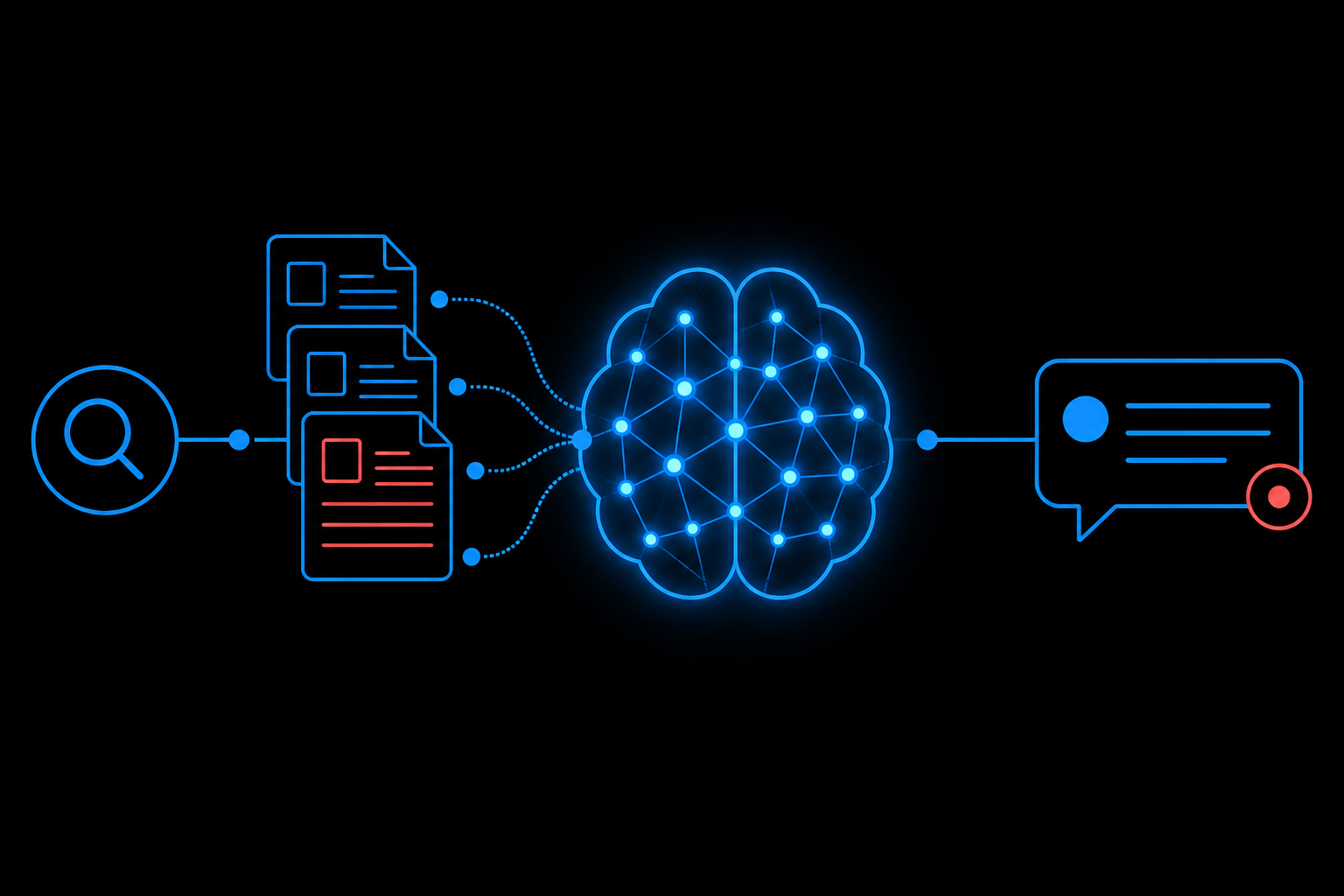
The answer-engine pipeline, step by step
Most modern answer engines follow the same four stages: interpret the query, retrieve candidate passages, rank and weigh them, then generate a synthesized answer with citations.
- Interpret — the engine parses intent and expands the query into sub-questions.
- Retrieve — it pulls candidate passages from the live web, an index, or its own store.
- Rank — it scores passages for relevance, clarity, and trustworthiness.
- Generate — the LLM composes an answer and attributes the passages it leaned on.
What is retrieval-augmented generation (RAG)?
RAG is the architecture behind most citable AI answers: the model retrieves relevant documents first, then generates a response grounded in them. This is why clean, well-structured source content matters so much — the model quotes what it can extract cleanly.
Structure dramatically improves extraction accuracy. In one widely-cited benchmark, giving a model a labeled knowledge-graph view of data instead of raw tables lifted answer accuracy from roughly 17% to 54%. The lesson transfers to web pages: labeled structure beats unstructured prose.
The five factors that decide which sources get cited
Across engines, five factors dominate source selection: extractability, structure, trust, entity clarity, and corroboration.
| Factor | What it means | How to earn it |
|---|---|---|
| Extractability | A self-contained answer | 40–60 word answer blocks |
| Structure | Machine-readable hierarchy | Question H2s, lists, tables |
| Trust | Credible, current source | Authors, sources, updated dates |
| Entity clarity | Knows who you are | Consistent naming + schema |
| Corroboration | Echoed elsewhere | Reviews, PR, directories |
Engines are cautious about claims only a brand makes about itself. Independent corroboration is often the deciding factor — see Authoritativeness.
What this means for your content
If retrieval and extraction drive citations, then formatting is strategy. Lead with the answer, structure aggressively, add schema, and make trust obvious.
- Put the answer first; support it with evidence after.
- Break content into extractable chunks with descriptive headings.
- Mark up facts with schema so extraction is reliable.
- Reinforce authorship and freshness for trust.
Key takeaways
- Answer engines retrieve, rank, then generate — not rank-and-list.
- RAG rewards clean, labeled, extractable content.
- Five factors decide citations: extractability, structure, trust, entity clarity, corroboration.
Frequently asked questions
What is retrieval-augmented generation (RAG)?
RAG is a technique where an AI retrieves relevant passages first, then uses them to generate a grounded, citable answer instead of relying only on training data.
How do answer engines decide which sources to cite?
They retrieve candidate passages and weigh them for extractability, structure, trust, entity clarity, and corroboration, then synthesize the answer from the strongest matches.
Do answer engines read schema markup?
Yes. Engines like Gemini, ChatGPT, Perplexity, and Claude read structured data during extraction, which helps them interpret and attribute facts correctly.